


– Written by Sascha Ahrweiler, PHUSE Communications & Brand Strategy Director
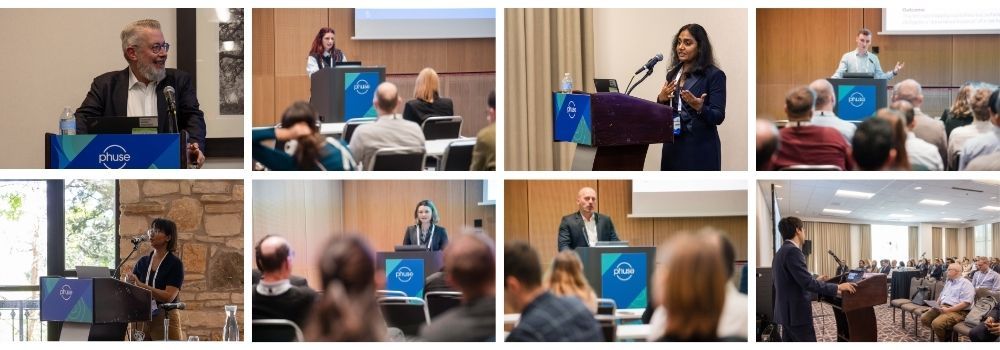
Over the past six months, I have had the privilege of attending all three PHUSE Connect events of the 2025–2026 season: Hamburg in November, the inaugural APAC Connect in Hyderabad in February, and Austin in March. Three cities. Three PHUSE communities. Three full conference programmes – which, with the support of AI, I have systematically compared across papers, authors, tracks and patterns.
What emerged is both exciting and unsettling. And I think it is worth sharing – not just the patterns, but the question that kept coming back as I read through hundreds of paper titles.
A Season of Records
Let me start with something worth celebrating: all three events recorded their highest-ever attendance. Whatever is happening to our profession, people are showing up to connect, share and advance about it. That matters. It signals that our clinical data science community is not a community retreating into silos. It is leaning in.
That is the good news.
AI Was Everywhere. But Was Disruption?
If there is one pattern that cuts across all three events without exception, it is this: AI was in almost every room, in almost every conversation, on almost every slide. From Hamburg’s Machine Learning track (16 papers) to Austin’s largest-ever Machine Learning track (35+ papers) to Hyderabad’s AI-saturated agenda, across every category the vocabulary has shifted. We are no longer debating adoption. We are debating governance, validation, orchestration, and the human-in-the-loop question. It seems as if we are all looking for a North Star to enlighten us as to where we as an industry should go to stay relevant. Some came up with new job descriptions for new roles in the AI area. Those job descriptions were probably accurate when the abstract was written, but six months later they already seem obsolete due to the fast pace of the AI disruption. And no one can deny that AI will have a huge disruptive impact on us all.
That is progress. Real progress. And it is great to see that PHUSE once again is paving the way towards emerging technology becoming business as usual.
And yet, sitting with the full dataset – more than 600 posters and presentations across three events – I kept noticing what was not there.
The industry has clearly recognised the power of AI. The tools are being evaluated. Pipelines are being built. Agents are being deployed. Papers on agentic workflows, LLM-assisted ADaM generation, and automated TFL pipelines appeared at all three events, reflecting genuine implementation momentum.
But recognising the power of something is different from recognising its disruption. Power is what it can do for you today. Disruption is what it does to your world. This includes the parts you haven’t chosen yet.
Hamburg gave us Neither Magic Wand Nor Terminator: Finding the Sweet Spot in AI-Assisted Coding and Human in the Middle: Accelerating with AI, Anchored in Quality. Thoughtful, calibrated, appropriately cautious. Austin created a bigger sense of urgency with The AI Reckoning: Why Statistical Programmers Must Evolve Now. Hyderabad gave us The Half-Life of Skills: Leading When Today’s Expertise is Tomorrow’s Obsolete.
These are thought-provoking papers. But they remain, for the most part, technical or have too narrow a focus in response to a real transformation that is also – perhaps primarily – a strategic and philosophical one. It is once again the belief that we can simply learn a new technology and everything will work out eventually. I mean, didn’t we all go through a recent transformation when we learned R and began using it as a primary language instead of SAS®?
The question I kept asking was: has our industry truly reckoned with what AI will do to the value chain we sit inside? Not just to the code. Not just to the workflow. But to the fundamental question of why a statistical programmer exists, what the drug development process is optimised for, and who ultimately benefits from the data we steward.
There were panel discussions where this popped up. I found relatively few papers willing to go there, though, and I think that absence is itself a signal worth naming.
The Hidden Gems
To be fair, some papers did venture towards the WHY – and they deserve to be highlighted, because they are easy to miss in our busy agendas.
In Austin, Kris Wenzel’s What Pharma Can Learn from Data Science Outside the Industry (MMS Holdings) asked a question that should unsettle anyone comfortable in our professional bubble: what are we missing precisely because we only talk to ourselves? That paper belongs on more reading lists than it probably landed on. I’d love to see more papers like this at PHUSE. Looking beyond our own industry and trying to learn always helps.
Also in Austin, Lydia Matombo’s Equity as a Dimension of Quality: Embedding Equity into Risk-Based Quality Mangement (Clinavence) pushed the conversation towards something most pharma conferences treat as peripheral: who is included in the data we generate, and whose outcomes we are actually measuring. That is not a diversity box to tick – it is a fundamental question about what quality means in clinical research. It describes the quality through the lens of our customers.
In Hamburg, James Zee’s Rethinking Automation in the AI Era (MMS Holdings) asked whether we are automating the right things when taking a holistic approach – and whether our instinct to automate is itself worth interrogating.
These are the kinds of papers which might help the global PHUSE Community further excel. Not because they have the answers, but because they are asking the harder questions. They were present at all three events – but they were outnumbered, and not always in the spotlight. A call to action to those of you who are thinking about sharing your thoughts through a different lens in the upcoming PHUSE Connect season: don’t shy away from asking the tough questions and stimulate a provocative discussion. Call for papers for the PHUSE EU Connect is still open. Do you fancy a real thought-provoking paper? Don’t stop yourself, and reserve me a seat.
Three Events, One Story Arc
Comparing the three events across their full agendas reveals something that feels less like three separate stories and more like one continuous narrative told from three different vantage points.
Hamburg was the most methodologically balanced event of the three – strong open-source adoption discussion, rich people leadership content, genuine intellectual debate about AI with appropriate scepticism. The European community brought its characteristic rigour, with 17 papers in the Open-Source track alone. A profession in the middle of a tooling transformation, thinking carefully about what it means.
Hyderabad was the most energetically optimistic – and the most honest about anxiety in the same breath. The APAC statistical programming community is not behind, but differently positioned. It is building fast, training hard, and facing the full disruption without the legacy insulation that Western functions sometimes enjoy. The estimands cluster was genuinely sophisticated. The AI-in-practice papers were ambitious. And the Professional Development track had some of the rawest, most honest titles of any event this season.
Austin was the most operationally mature – but also the most revealing about what comes after early adoption. The AI governance conversation in Austin had a specificity that only comes from organisations that are already deep inside the implementation. Validation frameworks for agentic systems. Risk-tiered oversight. Audit readiness for LLM-generated outputs. These are not future concerns in Austin. They present challenges.
The arc across the three: from thoughtful adoption (Hamburg) → building with ambition and existential honesty (Hyderabad) → governing a system already in motion (Austin). Three stages of the same transformation, visible simultaneously in three regional PHUSE communities.
The Question Worth Taking into the Next PHUSE Connect Season
I began by asking whether our industry has recognised the disruptive impact of AI – not just the operational one. My honest answer, after a season of three events and hundreds of papers, is partial, and uneven.
The technical adoption is real. The governance conversation has started. The workforce anxiety is visible and being named, which is itself progress.
What is still largely missing is the upstream conversation. The one about why our function exists. About what the pharmaceutical value chain actually optimises for, and whether AI changes that optimisation or merely accelerates it. About who the data caterer, the data agent, the data guardian – or, in other words, the next evolution of the statistical programmer or the clinical data scientist – ultimately serves and whether ‘the patient’ is a genuine answer or a useful phrase. Our first principles – a mental model to enable disruptive thinking – has to circle around the patient.
Like him or not, Elon Musk is one of the most instructive examples of what first principles thinking looks like when it makes contact with reality. He didn’t ask how to improve rockets. He asked what a rocket fundamentally needs to do and what it would cost to achieve that if you discarded 60 years of aerospace assumption. That question, taken seriously, collapsed the price floor of an entire industry. Who is asking this question for us?
The question our profession needs to ask is the same in structure, if not in scale: what is a TFL actually for? Why do we produce CDISC-compliant SDTM and ADaM datasets? Not how we produce it all – but what it fundamentally needs to achieve. If the answer is ‘help a decision-maker understand a pattern in data’, then a lot of what surrounds that output starts to look less like process and more like archaeology.
That conversation was present at the margins of all three events. The papers I flagged above were there. But they were not the centre of gravity.
Maybe that is appropriate for now. Maybe we’ve just started to realise the disruptive effect of generative and agentic AI. Maybe you build the tools before you interrogate the purpose. Maybe the governance conversation is a necessary precursor to the philosophical one.
But I would be lying if I said I wasn’t waiting for the session that starts not with ‘here is what AI can do for our workflow’ but with ‘here is what we are actually for, and whether we are still serving that purpose’.
I am still waiting for that session.
I hope someone, not a machine, writes it for the next season.